"As a Deputy Head in a large secondary school I was involved in taking part in a city wide health and wellbeing survey over a period of six years. Completing the survey every two years grew in importance year on year, with the final cycle having a major impact on our SDP, PHSE curriculum, Ofsted outcomes and governor understanding.
Over the six year period we moved from a small sample in two tutor groups filling in a paper survey to two year groups completing an online survey. The reports produced give graphical analysis of a wide range of issues. As a result of the survey we increased the number of PSHE workshop days for students to address issues such as smoking, drug and alcohol awareness, anti-bullying workshops. The surveys helped Governors make a positive informed decision to allow Brook Advisory Clinic nurses on site to support students.
As a result of taking part and using the evidence provided we were able to offer more support for students which had a direct impact on improved attendance and outcomes."
Bullying: turning the curve at last?
Bullying: turning the curve at last?
For over 15 years, we have been asking secondary pupils across the country the same question: Do you ever feel afraid of going to school because of bullying? The pupils are offered four responses, Very often, Often, Sometimes and Never. The proportion saying anything other than 'Never' veries between 20% (Year 10 males) to over 30% (Year 8 females). And it's been that way for a long while.
I have struggled to understand for a while why our bullying figures are so flat. For the last decade and more, schools have made more and better efforts to address bullying, and the list of initiatives and strategies we have seen is long (see, for example, https://www.antibullyingweek.co.uk/ ). Yet for all these efforts, the figures on young people's feelings about safety at school have been stubbornly stable, neither going down nor up.
That's actually the least expected result. We would obviously like to see a fall in young people's fears of bullying at school, although we could also imagine that figures might go up, as young people become more aware of it, and/or more inclusive about what they think of as being 'bullying'.
However, our most recent set of charts shows some evidence of change, at last, and the change is in a very desirable direction.
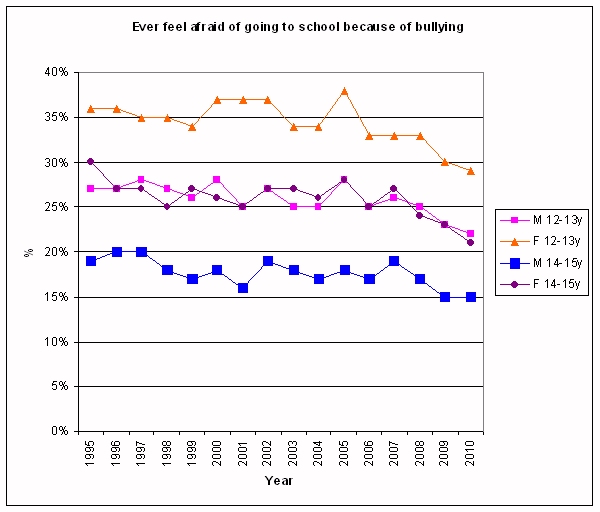
We see falls in all four groups, consistent over the last four years or so. Our usual health warning is, we survey with clients in different parts of the country each year, so it's not really 'national figures', but it's common for a given area to survey every 2 years, and so the bulk of the 2008 sample was made up of the same areas as 2010. So that's very suggestive.
Of course, if there is only one pupil who is afraid of going to school because of bullying, that is too many.